
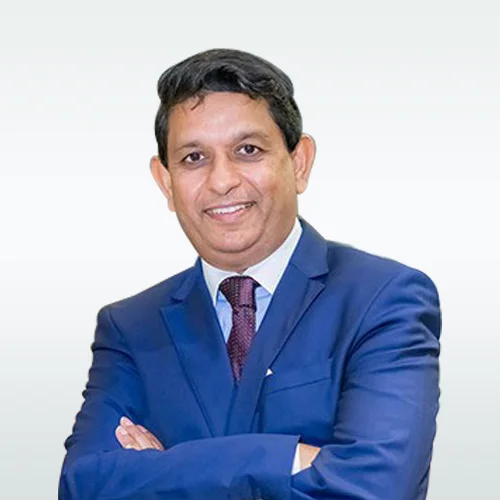
Dr. Sandeep Jain
Director / Registered Dentist
BDS (Delhi), MDS (Perio) (HK), AdvDipPeriodont (HK)
MRD RCSEd (Perio), MRACDS (Perio)
Speaks English, Hindi, Punjabi

A wisdom tooth that has fully come through and sits in a normal position can usually be removed in a simple extraction of about 30–60 minutes. Most people can return to work or school within 1–3 days and feel fully back to normal in about a week. Your dentist will usually suggest removal if a wisdom tooth is impacted, decayed, or keeps getting inflamed and is affecting the tooth next to it or making the area hard to keep clean.
Wisdom teeth, or third molars, often emerge in your late teens or early twenties. Removal may be recommended if:
After a thorough exam with X-rays, our Discovery Bay team will determine if wisdom teeth removal is right for you.
For straightforward cases, your dentist can perform wisdom teeth removal in a single visit. The procedure takes 30–60 minutes, using local anaesthesia to keep you comfortable.
If bone removal or surgical expertise is needed (e.g., fully impacted teeth), we’ll schedule you with one of our oral surgeons. These cases may take 60–90 minutes and can involve sedation or general anaesthesia for added comfort.
We use X-rays to assess tooth position and plan the extraction.
The tooth is carefully removed, with minimal discomfort thanks to our precise techniques.
You’ll go home with pain medication, antibiotics, and detailed instructions.
A sideways wisdom tooth is one type of impacted wisdom tooth. It sits at an angle or lies flat inside the gum and jawbone and cannot come through normally. These teeth usually need to be removed surgically.
Wisdom teeth are the last teeth to come through, usually starting between the ages of 18 and 25. If there isn’t enough room at the back of the jaw, the tooth grows in whichever direction meets the least resistance. It may tilt forward against the second molar or lie on its side in the bone. The shape of the roots and how close the tooth sits to the nerve in the lower jaw both affect how difficult removal will be. Your dentist therefore takes an X-ray first and, where needed, arranges 3D imaging to confirm where the roots and nerve are. Our Main Plaza clinic has 3D CBCT for this.
A simple extraction is for a wisdom tooth that has come through and can be gripped directly. The dentist loosens it with instruments and lifts it out. A surgical extraction starts with a small cut in the gum and lifting a small flap of tissue to expose the buried crown of the tooth. If the roots are curved, or the angle makes the tooth hard to remove in one piece, the dentist divides it into sections and removes them one at a time, then cleans and stitches the area. Stitches are usually removed by the dentist 1–2 weeks later, though dissolvable stitches are sometimes used. The extra steps mean surgical extraction takes longer, and swelling afterwards is usually more noticeable than after a simple extraction.
Most impacted wisdom tooth surgery can be done under local anaesthesia. Once it takes effect you usually won’t feel pain in the area, although you will still feel pressure. If you do feel pain, signal straight away and the dentist can give more anaesthetic. If you feel nervous about dental treatment, or your case is more complex and will take longer, you can discuss sedation dentistry or general anaesthesia with your dentist. Whether it suits you depends on your health and is assessed by the dentist and an anaesthetist. At your consultation, your dentist will use your X-ray to explain which option applies to you.
With wisdom teeth removal at Bayside Dental, you’re in caring, expert hands from start to finish.
Based on the Prince Philip Dental Hospital private patient fee schedule and publicly available Hong Kong market information, removing one wisdom tooth has a reference range of about HK$5,000–$10,000. Where a case sits in that range depends on how the tooth is removed and how complex it is. The main factors are:
| Factor | How it affects the fee |
|---|---|
| Tooth position | A fully erupted tooth that can be lifted out directly sits at the lower end. Surgical removal, where the gum has to be opened, costs more. |
| Complexity | Curved or divided roots, or a tooth buried deep in the bone, take more time and skill, so the fee goes up. |
| Distance from the nerve | When the roots of a lower wisdom tooth lie close to the inferior alveolar nerve, the procedure needs more careful planning and the fee is usually higher. |
| Anaesthesia | Local anaesthetic costs less. Sedation or general anaesthesia, if needed, requires an assessment and is charged separately. |
| Imaging | Cases that need only standard X-rays cost less. If a 3D CBCT scan is needed to locate the roots and nerve, an imaging fee is added. |
These ranges are based on the Prince Philip Dental Hospital private patient fee schedule and publicly available market information, and are for reference only. They are not Bayside Dental Discovery Bay’s fees, and they are not a fixed quote or a guarantee of the final cost. Your dentist will set your final wisdom teeth removal cost after a clinical assessment. Fees for other treatments are on our Hong Kong dental fee reference page.
A regular extraction usually involves a tooth that has already come through and has fairly straight roots, so the procedure is relatively simple. Wisdom teeth are often impacted, have curved roots, or sit close to the nerve.
The main difference is the assessment beforehand. For a regular extraction, a clinical examination and one X-ray are usually enough. For a wisdom tooth, the dentist needs to work out the angle of the tooth, how many roots it has and where the nerve runs. Afterwards, swelling from a regular extraction is usually mild, while wisdom tooth surgery usually means a few days of soft food and rest. If you need a dentist to take out a wisdom tooth and aren’t sure which applies to you, you can book a check-up at our North Plaza or Main Plaza clinic.
A simple extraction of a fully erupted wisdom tooth usually takes about 30 to 60 minutes; impacted or deeply buried teeth that need the gum opened and the tooth divided take about 60 to 90 minutes. This doesn’t include the examination beforehand, waiting for the anaesthetic to work or resting afterwards; your dentist will estimate the time from your X-ray.
The Prince Philip Dental Hospital fee schedule lists wisdom tooth removal (surgical or non-surgical) at about HK$5,000–10,000 and a simple extraction at HK$700–2,000. Impacted teeth that need surgery usually sit at the higher end, and X-rays or sedation may be charged separately. These figures are for reference only and are not our clinic’s actual fees; your fee is confirmed after examination. See our Dental Fee Reference.
Swelling and discomfort are usually worst on days 1 to 3 and ease on days 4 to 7; most people can return to work or school within 1–3 days and feel fully back to normal after about a week. Surgical extractions usually swell more than simple ones. Take pain relief as your dentist advises and don’t exceed the dose. If the pain gets worse a few days after surgery (around days 3–5), or you develop a fever, contact the clinic.
You can eat once the anaesthetic has fully worn off, usually within a few hours. For the first two or three days, choose soft, lukewarm foods such as congee, noodles in soup, steamed egg, tofu and yoghurt, and chew on the other side. Avoid very hot, spicy, hard or crumbly foods, and don’t use a straw, because the suction can disturb the blood clot in the socket.
Local anaesthetic usually wears off within about two to five hours, depending on the dose and the person. Until then your lip, cheek and tongue will feel numb, so take care not to bite them, and avoid very hot drinks so you don’t burn yourself without noticing. Return to normal eating once the numbness has completely gone.
A common approach is to remove the upper and lower teeth on the same side together, so you can still chew on the other side; some people prefer one tooth at a time to shorten each recovery. If all four need removing, your dentist will discuss whether to do it in stages or together under suitable anaesthesia, and how recovery differs.
Some oozing is normal. Bite firmly on gauze for about 30 to 45 minutes as instructed so a clot can form, and avoid checking it or spitting often. For the first 24 hours, apply a cold pack to the outside of your cheek on and off, about 10 to 15 minutes at a time. On the day, avoid strenuous exercise, alcohol and smoking, and sleep with your head raised. Call the clinic straight away if bleeding continues for several hours, swelling is clearly getting worse after day three, or you have a fever or trouble swallowing.
The more common issues are pain, swelling, bleeding and dry socket, where the blood clot comes away too early and the socket becomes very painful. Occasionally, when the roots of a lower wisdom tooth sit close to the nerve, the lip or tongue can feel numb afterwards; this is usually temporary, but rarely it can last longer. Your dentist checks the position of the roots and nerve on an X-ray (and a 3D scan if needed) beforehand and explains the risks with you.
Director / Registered Dentist
BDS (Delhi), MDS (Perio) (HK), AdvDipPeriodont (HK)
MRD RCSEd (Perio), MRACDS (Perio)
Speaks English, Hindi, Punjabi

Having trouble with your wisdom teeth? Your dentist will examine them first and advise whether removal is needed. Both clinics are in Discovery Bay — choose the one closest to you: