
Quick answer: Gum disease is a bacterial infection of the tissues that hold your teeth in place. It begins as gingivitis, where the gums become red and bleed easily, and can advance to periodontitis, where the supporting bone is gradually destroyed. Caught early, it is usually reversible.
- Warning signs: gums that bleed when you brush or floss, persistent bad breath, tenderness or swelling, gums that look longer than they used to, and teeth that feel loose or have started to drift apart.
- Is it reversible? The earliest stage, gingivitis, generally resolves completely once plaque and hardened deposits are removed and home care improves. Bone lost to periodontitis does not grow back on its own, so treatment then shifts to halting further damage.
- When to see a dentist: book an assessment if bleeding continues beyond a week or two despite careful brushing and flossing, or at any point if you notice recession, looseness or a bad taste that will not clear.
Bleeding gums are easy to write off. A little pink in the sink feels minor, and because gum problems are rarely painful in the early years, most people wait for discomfort that never arrives until the damage is well advanced. That delay is why periodontal disease remains a common cause of tooth loss in adults.
The useful thing to understand is that gum disease is not a single condition but a progression, and each point along it carries a different outlook and a different treatment path. Knowing where you sit on that scale tells you whether you are dealing with something a cleaning and better habits will fix, or something that needs structured periodontal care.
Gingivitis vs Periodontitis: What’s the Difference?
Gingivitis is inflammation limited to the gum tissue, with no damage to the bone underneath, which is why it can usually be reversed completely. Periodontitis is what happens when that inflammation spreads below the gum line and destroys the bone and fibres anchoring the tooth. That damage does not reverse on its own, so treatment aims to halt it.
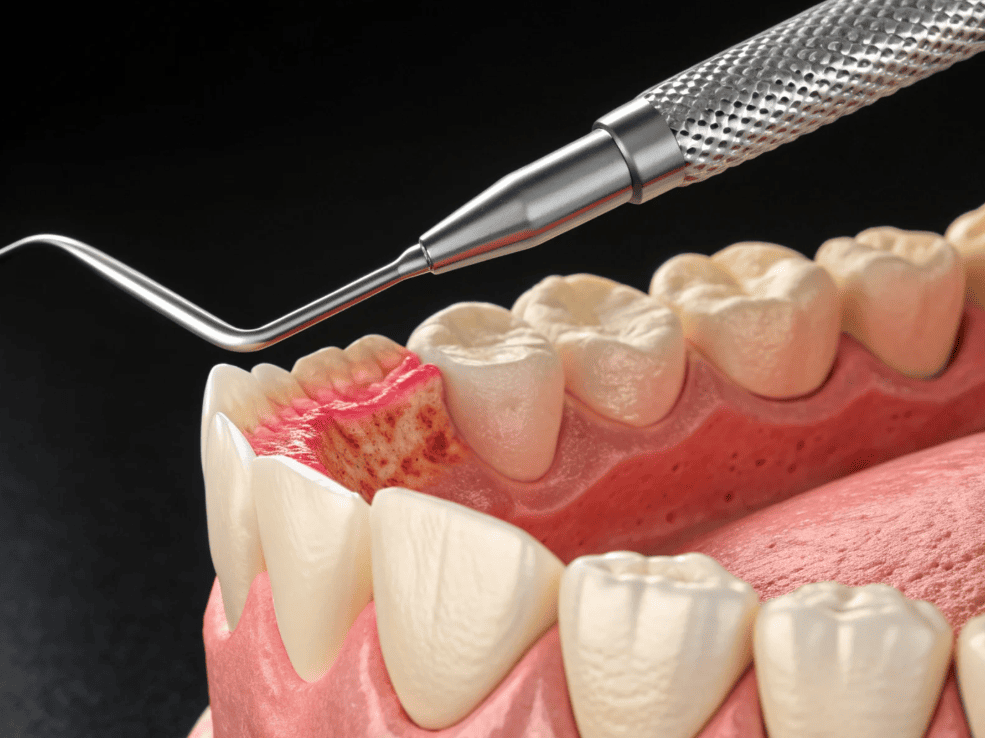
The distinction matters more than the terminology suggests, because both look almost identical from the outside. Red gums, bleeding, a bit of swelling. What separates them is invisible without an examination, so dentists tell them apart by measuring. A small calibrated probe is walked gently around each tooth to record how deep the gum cuff sits against the root. A healthy sulcus measures roughly one to three millimetres, and anything deeper suggests the attachment has pulled away and a periodontal pocket has formed. X-rays then confirm whether the bone level has dropped.
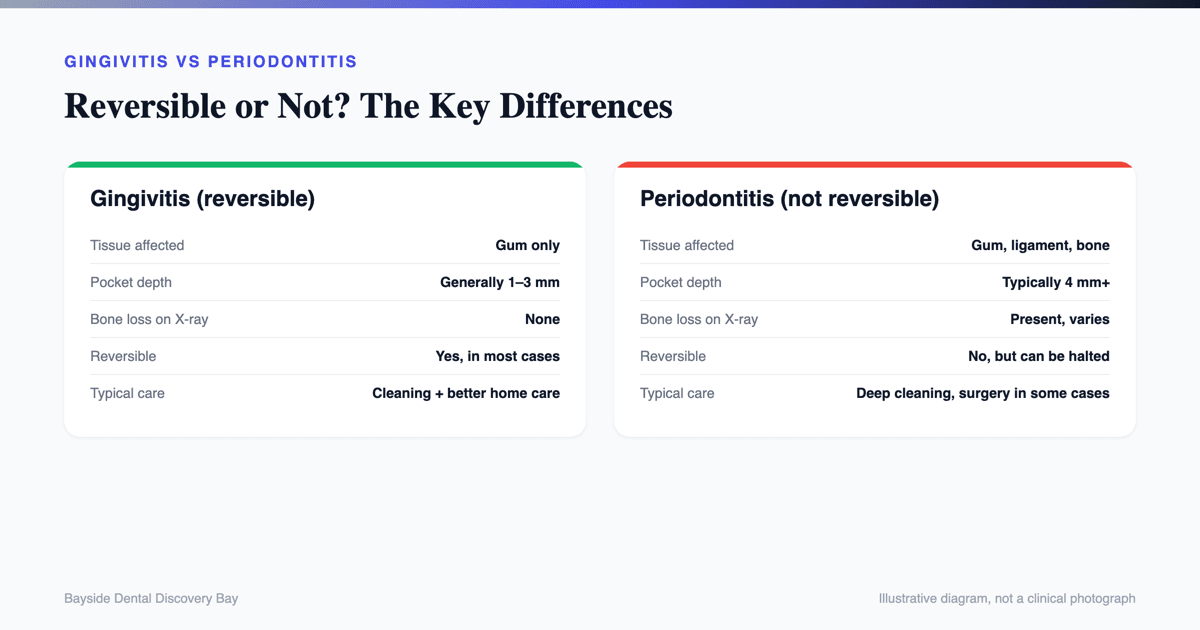
| Gingivitis | Periodontitis | |
|---|---|---|
| Tissue affected | Gum only | Gum, ligament and bone |
| Pocket depth | Generally 1–3 mm | Typically 4 mm or deeper |
| Bone loss on X-ray | None | Present, varying in severity |
| Reversible | Yes, in most cases | No, but progression can usually be halted |
| Typical management | Professional cleaning plus improved home care | Deep cleaning below the gum line, ongoing maintenance, surgery in some cases |
If your gums bleed but nothing has loosened and no gaps have opened up, there is a reasonable chance you are still in the reversible zone. Our companion article on understanding gum inflammation covers that early stage in detail, including the daily habits that most often turn it around. The rest of this guide picks up from the point where inflammation has been left alone long enough to start doing structural harm.
The 4 Stages of Gum Disease
Gum disease is usually described in four steps: healthy gums, gingivitis, mild to moderate periodontitis, and advanced periodontitis. Movement between stages is gradual and can take years. The transition that matters most is the second one, because that is where the damage stops being reversible and starts being permanent.
Stage 1: Healthy Gums
Healthy gum tissue is pale pink or, depending on your natural pigmentation, may carry darker patches that are entirely normal. It sits snugly around each tooth in a scalloped outline and feels firm rather than spongy. The defining feature is that it does not bleed. Many people assume a little blood is standard, but common and normal are not the same thing.
Stage 2: Gingivitis
Plaque left in place for roughly a day begins to provoke a response. Blood flow increases, the margins turn a deeper red, the tissue swells slightly and becomes fragile, and bleeding on brushing appears. Breath may turn stale in a way mouthwash masks briefly without resolving.
At this point no attachment has been lost and the bone is untouched. Remove the plaque and hardened tartar, keep the area clean afterwards, and the tissue generally returns to health within one to two weeks. This is the stage where the outcome is almost entirely in your hands.
Stage 3: Mild to Moderate Periodontitis
When gingivitis persists, the inflammation eventually breaks through the seal between gum and tooth. The gum detaches slightly from the root, and the resulting space becomes a periodontal pocket. Pockets are difficult to clean at home because a bristle cannot reach below the gum margin, so bacteria that thrive without oxygen settle in and multiply.
Bone begins to resorb around the affected teeth and pockets deepen to four or five millimetres, sometimes more. Gums may recede, exposing part of the root and often causing sensitivity to cold, and small dark triangles can appear between teeth where the gum used to fill the space. Teeth usually still feel solid here, which is exactly why so many people delay treatment.
Stage 4: Advanced Periodontitis
In advanced disease, a substantial proportion of the supporting bone has been lost. Pockets often exceed six millimetres and are hard to manage even with professional cleaning. Teeth loosen because the foundation holding them has diminished, and they may shift position, tilt outward or change how they meet when you bite. Abscesses can flare up, producing swelling, throbbing and a persistent unpleasant taste.
Treatment at this level is about salvage and stability. Some teeth can be kept with intensive periodontal care and long-term maintenance. Others may be too compromised, and a dentist will discuss whether extraction and replacement is the more predictable route.
Symptom Self-Check
The list below is not a diagnosis, but the more items that apply, the stronger the case for booking an examination rather than waiting to see whether things settle.
- Blood appears when you brush or floss, even occasionally
- Bad breath keeps returning despite regular cleaning
- Gums look swollen, shiny or darker red than usual
- Your teeth appear longer, or roots feel exposed and sensitive
- Gaps have opened up between teeth that used to sit close together
- One or more teeth feel slightly mobile when you press them
- Your bite feels different, or a denture or bridge no longer fits as it did
- Gums are tender, or pus appears at the gum margin
What Causes Gum Disease?
Gum disease is driven by dental plaque, a soft film of bacteria that reforms on tooth surfaces within hours of cleaning. Left undisturbed, plaque hardens into tartar, which cannot be brushed off and holds more bacteria against the gum line. The body’s inflammatory response to that bacterial load is what ultimately breaks down attachment and bone.
The chain of events runs in a fairly consistent order:
- Plaque accumulates, particularly along the gum margin and between teeth where a brush reaches poorly.
- Tartar forms as minerals in saliva harden that plaque into a rough calcified deposit, usually within two to three days. Its texture gives fresh plaque an ideal surface to cling to.
- Pockets develop as sustained inflammation loosens the attachment between gum and root, creating a sheltered space home cleaning cannot reach.
- Bone is lost as the inflammatory process extends to the bone surrounding the root. This is the point of no return in terms of natural recovery.
Plaque is the trigger, but it does not affect everyone equally. Two people with similar oral hygiene can end up in very different places, and that variation comes down to risk.
Factors That Raise Your Risk
- Smoking and tobacco use. Tobacco impairs blood flow in the gum tissue, which both accelerates breakdown and suppresses bleeding, so the disease often advances further before it is noticed. Healing after treatment also tends to be slower.
- Diabetes. Elevated blood glucose affects immune function and tissue repair, and the relationship runs in both directions.
- Hormonal changes. Pregnancy, puberty, the menstrual cycle and menopause all alter how gum tissue responds to the same amount of plaque.
- Genetics and family history. Susceptibility to aggressive bone loss clusters in families, so if a parent lost teeth to gum problems, earlier screening is sensible.
- Stress and reduced immune function. Both weaken the body’s ability to contain a bacterial challenge.
- A persistently dry mouth. Saliva clears bacteria and buffers acid, so anything that reduces it lets plaque build faster.
- Crowded teeth and older restorations. Overlapping teeth and worn crown or filling margins create traps that are genuinely hard to clean.
Risk factors do not cause the disease by themselves. They determine how quickly it progresses and how aggressively it needs managing once diagnosed.
How Is Gum Disease Treated?
Treatment is matched to how far the disease has progressed. Early cases are usually handled with a professional clean and revised home care. Moderate cases need deep cleaning below the gum line, performed under local anaesthetic. Advanced cases may require periodontal surgery. Every plan starts with a full examination, pocket measurements and X-rays.
Early Stage: Professional Cleaning and Home Care
Where inflammation is confined to the gum tissue, removing the deposits provoking it is normally enough. A hygienist or dentist clears plaque and tartar from the surfaces above and just below the gum margin, then polishes the enamel so fresh plaque has less to grip. Most people notice the bleeding settling within a couple of weeks.
The appointment is only half the work. Technique review matters just as much, since the areas that develop problems are almost always the ones missed daily. Our teeth cleaning guide covers what a scaling appointment involves step by step, plus aftercare and recommended intervals.
Moderate Stage: Deep Cleaning (Scaling and Root Planing)
Once pockets have formed, a routine clean cannot reach the deposits sitting on the root below the gum. Scaling and root planing addresses that. The dentist works beneath the gum line to remove hardened deposits and bacterial contamination, then smooths the root so the tissue has a clean surface to heal against.
Because the instruments work below the gum margin, the area is numbed with local anaesthetic beforehand. Treatment is commonly divided by quadrant, meaning the mouth is split into four sections with one or two completed per visit. That keeps each appointment manageable and limits how much of your mouth is numb at once.
A review is typically scheduled six to eight weeks later, once the tissue has had time to respond, and pockets are re-measured to see which areas have improved. Where clinically appropriate, your dentist may prescribe supporting treatment alongside the mechanical cleaning.
Advanced Stage: Periodontal Surgery
Deep pockets sometimes persist after non-surgical treatment, particularly around back teeth or where the root anatomy is complex. A surgical approach may then be discussed, from lifting the gum to gain direct access to the root and reshape the underlying bone, through to grafting techniques intended to regenerate lost tissue in suitable cases.
Surgery is not automatic at this stage and is not right for every patient. Whether it suits you depends on the pattern of bone loss, how the tissue has responded so far, general health, smoking status and how realistic long-term maintenance is. It is decided with your dentist after the non-surgical phase has been completed and reassessed, not at the first appointment.
What Does Gum Disease Treatment Cost?
Fees vary with the number of quadrants involved, pocket depth, how many review visits are needed and whether surgical care becomes necessary. For a sense of scale, the Prince Philip Dental Hospital private patient fee schedule places non-surgical periodontal treatment typically around HK$3,000–8,000 per quadrant as a market reference. Cases needing only a routine clean sit well below that.
Price ranges mentioned in this article are based on external market benchmarks (such as the Prince Philip Dental Hospital private patient fee schedule) and are for general reference only. They do not constitute a fixed quotation or final fee guarantee from Bayside Dental Discovery Bay. The final treatment fee will be determined by our dentists after professional clinical assessment of each individual case.
Can Gum Disease Be Prevented?
In most cases, yes. Gum disease develops when plaque sits undisturbed against the gum line, so prevention comes down to breaking that film up thoroughly every day and having the hardened deposits you cannot remove yourself cleared professionally. Regular screening then catches any early change while it is still straightforward to reverse.
At Home
Brushing twice daily for two minutes covers the basics, but where you aim matters more than how hard you press. The gum margin is the critical zone. Angling the bristles at roughly forty-five degrees toward that margin, using small circular or short back-and-forth movements, disturbs plaque where it does damage. Heavy scrubbing does not clean better and wears both enamel and gum tissue, so a soft brush and light pressure is the safer combination.
Cleaning between the teeth is the part most people skip, and the part that decides outcomes. A brush cannot reach the surfaces where teeth touch, which is precisely where gum problems tend to begin. Floss or interdental brushes once a day, ideally in the evening. If floss is awkward, interdental brushes are often easier to keep up with.
Beyond cleaning, stopping smoking makes a measurable difference to both risk and treatment response, and controlled diabetes supports gum health considerably. Replace your toothbrush every three months, or sooner once the bristles splay.
At the Clinic
A professional clean every six to twelve months removes tartar that has hardened beyond the reach of any home routine, with the interval set by your individual risk. Patients who smoke, have diabetes or have a history of periodontal treatment are often advised to attend more frequently, sometimes every three to four months.
Periodontal screening should be part of any routine examination. It takes a few minutes and involves probing around the teeth to check pocket depths, along with periodic X-rays to monitor bone levels. This identifies change before you can feel it, which is the strongest argument for keeping appointments when nothing appears wrong.
Frequently Asked Questions About Gum Disease
Can gum disease be reversed?
It depends which stage you have reached. Gingivitis generally clears completely once the deposits are removed and daily cleaning improves, so in that sense it is curable. Periodontitis is different. The bone that has already been lost does not regenerate by itself, so the realistic goal becomes stopping further destruction and holding the condition stable through treatment and ongoing maintenance rather than eliminating it outright.
Will I lose my teeth if I have gum disease?
Not necessarily, and most people who receive treatment do not. Tooth loss is the endpoint of untreated disease, not an automatic consequence of diagnosis. When periodontitis is identified and managed, and the patient keeps up both home care and maintenance visits, teeth frequently remain functional for many years. The outlook is less favourable for teeth that are already very mobile with severe bone loss, which your dentist will assess individually.
Is gum disease contagious?
The bacteria involved can transfer between people through saliva, so sharing cutlery, kissing or passing a toothbrush can move them from one mouth to another. That said, picking up the bacteria does not mean you will develop the disease. Whether it takes hold depends on your own plaque control, immune response and risk profile. Partners and family members of someone with periodontitis may benefit from a screening, but there is no need to avoid normal contact.
How is gum disease linked to diabetes?
The connection works in both directions. Raised blood glucose weakens the immune response and slows tissue healing, which makes people with diabetes more susceptible to gum problems and to faster progression. Running the other way, active periodontal inflammation appears to make blood glucose harder to control. Treating the gums may support better glycaemic control, which is why the two conditions are best monitored together.
Does deep cleaning hurt?
Local anaesthetic is used before scaling and root planing, so the procedure itself is generally comfortable and most patients report feeling pressure and movement rather than pain. Afterwards, once the numbness fades, the gums are often tender for a day or two and teeth can feel sensitive to cold for a short period. That usually settles on its own, and your dentist can advise on managing it if it lingers.
Can gum disease come back after treatment?
Yes, and this is the part patients most often underestimate. Treatment removes the bacterial deposits, but it does not change how quickly plaque reforms or alter your underlying risk factors. Without consistent cleaning between the teeth and regular maintenance appointments, pockets can deepen again. Patients who attend their recall schedule and keep up daily interdental cleaning usually hold their results well over the long term.
Speak to a Dentist in Discovery Bay
Gum problems respond well to early attention, and the assessment is straightforward. A periodontal examination measures pocket depths around your teeth and, where indicated, includes X-rays to check the bone level. From that, your dentist can tell you which stage you are at and what, if anything, needs doing.
Bayside Dental Discovery Bay operates two clinics on the island, so appointments can be arranged at whichever location suits you.
Discovery Bay North Plaza
- Unit 1, Ground Floor, Office Block 1, Discovery Bay North Plaza, Hong Kong
- Telephone: +852 2987 0855
- WhatsApp: +852 9787 3025
Discovery Bay Main Plaza
- Telephone: +852 2285 8068
- WhatsApp: +852 5977 3830
Opening hours: Monday to Friday 09:30–18:30, Saturday 09:30–13:30.
The information in this article is for general educational purposes only and is not a substitute for professional dental diagnosis, advice or treatment. Please consult a dentist regarding your own circumstances.